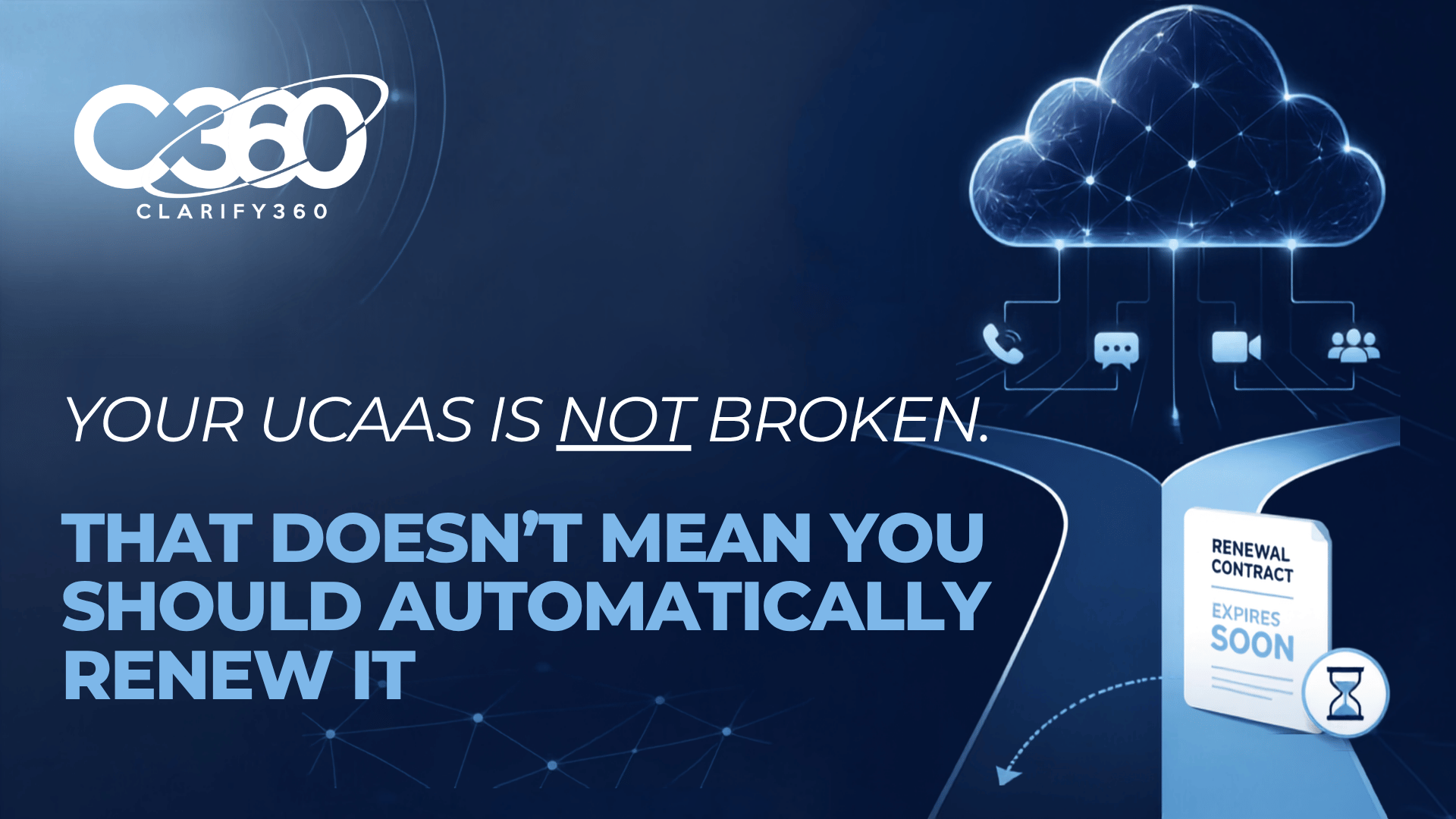
Your UCaaS Platform Isn’t Broken. That Doesn’t Mean You Should Renew It.
By Rachel Turkus, VP of Growth, Clarify360
If your communications platform is working, why would you replace it?
Fair question. Calls connect. Meetings happen. Employees can message each other. Customers can reach you.
Nobody is standing outside IT demanding a new phone system. So when renewal time comes around, the easiest thing to do is usually the obvious thing: renew it. But “nothing is broken” is a pretty low bar for technology your employees and customers use every day.
The better question is this:
If you were choosing your communications platform today, would you choose the same one?
That is the question I think companies should be asking before they sign another UCaaS contract.
Get the UCaaS Renewal Decision Matrix
Get our UCaaS Renewal Decision Matrix to quickly assess whether the right next step is to renew, optimize, renegotiate, benchmark, or transition.
1. How Much Work Is Your Platform Creating?
The cost of your communications platform is not just the number on the invoice. It is also the time your team spends managing it.
How much effort goes into adding users, changing settings, troubleshooting, supporting employees, dealing with integrations, managing locations, or working around things the platform should probably make easier?
A task does not have to be hard to be expensive. If your team has to do it over and over again, the time adds up. I think of this as the administrative tax of technology. It is the work everyone has accepted as normal because they have been doing it that way for years. Renewal is a good time to ask whether that work still needs to exist.
2. Are Employees Using the Platform—or Working Around It?
This is where feature lists can get a little ridiculous.
A platform can check every box on paper and still be annoying to use. What matters is what your employees actually do.
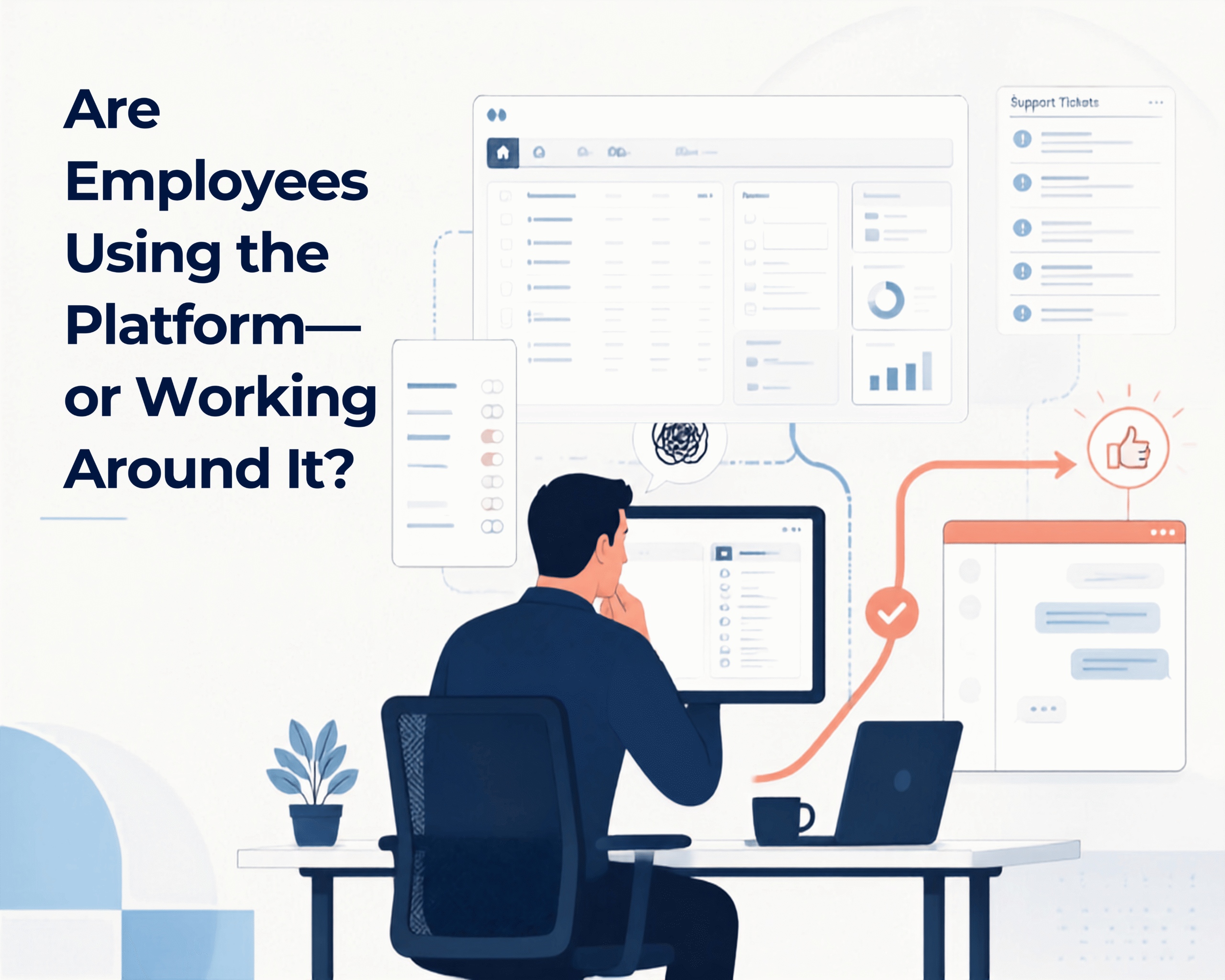
Are they using the messaging, meetings, collaboration, calling, and productivity features you are already paying for? Or are they jumping into other applications because those tools are easier?
Do new employees pick it up quickly? Can people find what they need without calling IT? Have teams gone off and bought their own tools because the company standard was not cutting it?
Poor adoption creates support tickets, redundant software, shadow IT, and wasted licensing. If employees are constantly working around the platform, that is not just a user-experience issue. It is a business issue.

3. Has AI Changed What You Expect From Your Communications Platform?
Probably.
AI has changed communications technology quickly, and the conversation is moving beyond whether a platform “has AI.” That question is almost meaningless now.
The better questions are: What does it actually do? Does it save anyone time? Does it help employees work better? Does it improve the customer experience? Is it native to the platform, or does it require another product? And are you already paying for some of these capabilities somewhere else?
Today companies are looking at things like real-time transcription, automated summaries, action-item capture, agent assistance, conversation intelligence, sentiment analysis, quality management, workforce optimization, and AI-assisted coaching.
That does not mean you need to switch providers. It does mean the requirements you had three years ago are probably not the requirements you have today. And that is worth evaluating before you sign another three-year agreement.
4. Are You Paying for the Same Thing Twice?
This one gets messy fast.
Most communications environments do not stay clean for very long.
You start with voice. Then meetings. Then chat. Then contact center. Then transcription. Then AI meeting notes. Then another customer experience tool. Then someone buys something else because one team wants a feature nobody realized you already had somewhere else.
Eventually, the stack starts looking like a junk drawer.
Before renewal, map the whole environment. Not just the phone bill. Look at voice, meetings, messaging, contact center, AI, collaboration, analytics, customer experience, and anything else employees are actually using.
Then ask three very simple questions: What are we paying for? What are people actually using? Where are we paying twice for the same capability?
Sometimes the answer is that you need a new platform. Sometimes the answer is that you need fewer platforms. Both are useful outcomes.
5. Has Your Business Outgrown the Platform?
The problem with a three-year technology contract is that your business usually does not stay the same for three years. You grow. You acquire another company. You add locations. You hire remote employees. Your customer service model changes. Security and compliance requirements change. Your employees start working differently.
And suddenly the platform that made perfect sense when you bought it feels a little less perfect. That does not necessarily mean the platform is bad. It may just mean your business moved on.
6. Your Contract Expiration Date Is Not a Technology Strategy
This is one of the biggest mistakes I see companies make. They know they should evaluate the market, but the contract does not expire for another six months. So they wait.
Then six months becomes three. Three months becomes six weeks. And suddenly there are demos to schedule, requirements to gather, pricing to compare, contracts to review, numbers to port, users to migrate, and integrations to test.
At that point, renewing becomes the easiest option. Not necessarily the best one. The easiest one.
Your contract should influence your timing. It should not make the decision for you. And yes, contract timing matters. But it may not box you in as much as you think. Some providers offer transition incentives or buyout programs that can change the economics of moving early.
That does not mean switch because someone is offering money. It means understand your options before you assume you do not have any.

What Kind of Problem Do You Actually Have?
Before You Renew, Figure Out What is Actually Wrong.
Not every problem requires a new provider.
- If the platform still fits, renew it—but benchmark pricing and terms first.
- If the technology works but the deal does not, renegotiate or right-size the agreement.
- If the biggest issue is admin burden, adoption, or workarounds, optimize first and evaluate alternatives if the friction remains.
- If the business has outgrown the platform, benchmark the market against your current requirements.
- And if you are dealing with security, compliance, reliability, or multiple major gaps, build a structured evaluation and transition plan.
There is no prize for switching vendors.
There is also no prize for staying with one because changing sounds annoying. The goal is to understand the problem first—and make the next decision from there.
Before You Sign Another UCaaS Contract
Your communications platform does not have to be failing for it to deserve another look.
Actually, the best time to evaluate technology is before it becomes a problem.
Your business has changed since the last contract was signed. The market has changed too.
So before you commit to another multi-year agreement, look at your environment, your costs, your requirements, and the alternatives available today.
Then decide whether the right next step is to renew, optimize, renegotiate, benchmark the market, or build a transition plan.
Not because the renewal notice landed in someone’s inbox. Because the platform still deserves your business.
Take the Guesswork Out of UCaaS Renewals

Talk to a UCaaS Specialist
Clarify360 can benchmark your current communications environment, pricing, capabilities, and available alternatives before you commit to another contract.
Get the UCaaS Renewal Decision Matrix
Get our UCaaS Renewal Decision Matrix to quickly assess whether the right next step is to renew, optimize, renegotiate, benchmark, or transition.

About the Author | Rachel Turkus
VP of Growth | Clarify360